Tuesday, September 15, 2015

Katrina: 10 Years Gone


Two boats passing, on the Mississippi River, New Orleans, LA (R. Schmidt)
Once again I tagged along with Susan to Sage Summit this year, held in New Orleans this past July. While Susan attended the conference, I was free to roam about and explore the city. I was interested in seeing the rebuilding and recovery as the city approached the ten-year anniversary of Katrina. The views of the paddlewheel steamboats plying the Mississippi River also brought back memories of the high school musical production of Show Boat that we put on my senior year. By the end of the trip, I had a veritable frappe of thoughts spinning in my mind, as these topics all became intertwined.

In essence, both New Orleans and Show Boat tell the story of two worlds living alongside each other along the banks of the Mississippi River: rich, poor, white, black, high ground, low ground.

When we got home, I could hardly wait to go rummaging in the garage and lay my hands on my old play book. Just as I remembered it, there were my carefully handwritten edits, crossing out “colored” folks, replaced with “poor” folks, “white” folks replaced with “rich,” such as:

Poor folks work on de Mississippi
Poor folks work while de rich folks play 


Spoiler Alert: If you haven’t seen the musical, some portions of the plot line are revealed below. Skip the next three paragraphs if you want to see the story unfold on the stage.


I think we believed ourselves to be fairly evolved at the time, and were properly horrified at the use of terms such as “colored.” At my Catholic, mostly white high school, it wasn’t lost on us the fact that we wound up having practically an all-white cast. Our director – Jon Rashad Kamal – worked with what he had, and quite cleverly cast sisters in the roles of Queenie, the black cook, and Julie, the virtuous leading lady who turns out to be of “mixed blood.” During one of the scenes, Queenie is surprised that Julie knows the song, “Can’t Help Lovin’ Dat Man,” as she’d only ever known colored/poor folks to sing that song. It was a very clever way to show a resemblance, at least symbolic, between the two characters in that way. He was a man before his time, rest in peace.
http://egy-plus.com/rashad/page1.php
 
Once it’s revealed that Julie and her husband Steve are guilty of miscegenation, or mixed marriage – illegal in those days (set in the 1880s) – Julie and Steve are run out of town. Of course, it also wasn’t lost on us, the fundamental injustice and unfairness of it all. Everyone had loved them before they knew about Julie’s mixed heritage. They were still the same people, nothing had changed, but in that moment, everything had changed.

The show then follows the story of Nola, the Captain’s daughter, who gets moved into the leading lady’s role, and falls for Gaylord Ravenal, a riverboat gambler. Nola is short for Magnolia, but could also symbolize NOLA, New Orleans Louisiana, a city that has had a long love affair with the gamble of living on land below sea level, on the Gulf Coast, and had relied on luck and hope that storms would veer off and avoid a direct hit. Of course, with Katrina, that luck ran out.

While visiting, I found a Katrina tour. I wanted to see and bear witness with my own eyes the land upon which such tragedy visited, truly hallowed ground. Such a tour could be accused of playing to morbid curiosity, and perhaps the same could be said for visitors to other such sites, the World Trade Center, the Boston Marathon finish line. I think it is simply human, an urge to connect. A desire to see, touch, feel, imagine what it must have been like. Consider the Biblical story of the Apostle who asked to see and touch the wounds in Jesus’ hands, and wound up being called Doubting Thomas as a result. Maybe it wasn’t doubt, but curiosity. Maybe he just in a similar way wanted to see and feel the wounds to make it more real, to try to feel the pain himself. I think it is like that. Our neighbor called us the other night. She was watching the 9/11 memorial shows on the History Channel, and asked us, “Why am I watching this? When it makes me so sad?” I said, “Maybe you just want to try to recall and feel their pain.”

The Katrina tour guide was a native of New Orleans, an older woman, who had lived through Katrina. She tried to educate us on the chronology and the reality of how the tragedy rolled out. Homes closest to the breaches in the levees or floodwalls got “fast water.” Water came in so fast and rose so quickly, there was little time to escape. Farther away from the breaches, there was “slow water,” and people had more time to seek escape. Some people went to their attics, and if they could, broke holes through the roof, and ultimately sought rescue from their rooftops.


House adjacent the London Ave. Canal floodwall (R. Schmidt)

It took two and a half days for the city to fill up with water, and three weeks to drain. We drove by the SuperDome (now the MetroDome), which was designated as a shelter, but lacked electricity, flush toilets, and air conditioning. After days of misery there, people were directed to the Convention Center, perched on higher ground along the river’s edge. People arrived there only to find the doors there locked, making a powerful symbolic, metaphorical statement about opportunity equalities. You can go knocking on the right doors, but still find them locked and opportunities unavailable to you.


Sadly, the rebuilding effort is uneven; skewed. Simply, the poorest neighborhoods have had the slowest and most difficult time recovering, and these neighborhoods tend to be predominantly black. A survey conducted by the Public Policy Research Laboratory at Louisiana State University found that blacks and whites had differing views on how completely the city had recovered post-Katrina. While the majority of whites viewed the city as mostly recovered, the majority of blacks thought the opposite (Robertson, 2015). To quote:

“Black residents, and in particular black women, report a harder time returning and rebuilding their lives after the storm. This is in part because of a couple of hard facts: African-Americans were far more likely to have lived in a flooded part of the city, and places that were worse-hit by the flooding, such as the Lower Ninth Ward, have taken much longer to recover.”


The survey also found negative views about recovery in the predominantly white neighborhoods outside New Orleans, such as Plaquemines and St. Bernard parishes, that were also catastrophically flooded. Black or white, then, the worse the extent of flooding, the more negative people felt about the recovery. But, in New Orleans, in general, the poor, black neighborhoods experienced the worst flooding.
 
It’s saddening and in ways shocking that the divides characterized in a 1927 musical are still in play today.

There is a great article in the Wall Street Journal by Leslie Eaton and Cameron McWhirter that chronicles the disparities in recovery. There are some bright spots, in that tourism – measured in terms of both the number of visitors and dollars spent per year – has practically returned to pre-Katrina levels.  However, this has spawned an increasing number of low-paying jobs in the restaurant industry, most typically held by black workers, “widening the economic divide between whites who are generally richer than before, and blacks, who aren’t.” It’s worth checking out the entire article:
http://www.wsj.com/articles/the-new-orleans-economy-ten-years-after-katrina-1440628953

It really is about opportunity inequalities. And the answer in terms of how best to level the playing field may come from a simple, but surprising corner: each other. Dr. Daniel Aldrich had just moved to New Orleans when Katrina struck, and as a result of that experience, has redirected his area of study from political science to disaster recovery and community resilience. He is now serving as Co-Director of Northeastern University’s Masters in Security and Resilience Studies program. In an interview with Bella English of The Boston Globe, he’s quoted as saying, “What I found was that the strength and cohesion of a community before the disaster was one of the best predictors for recovery after.” Ms. English writes: “It was social capital – not money poured into infrastructure – that most quickly led to recovery, no matter how poor the community.” And: “The power of friends, family and neighbors means that they, in effect, are the real first responders.”

So, it was appropriate and sobering that the last stop on the Katrina tour was the tomb of the unknown, 83 souls lost who were never identified. Maybe everyone who knew them, who could have identified them, also perished in the flood. The tomb of the unknown victims is doubly sad. It is almost a universal fear, the thought of dying alone, and lonely, and that is the death they experienced. It is the least we can do to remember them, mourn and honor them now.  


Post Script – Show Boat
Show Boat was based on the novel by Edna Ferber, with music by Jerome Kern, and playbook and lyrics by Oscar Hammerstein 2nd. The musical spans riverboat life in Natchez, Mississippi from the 1880s into the early 1900s. 

Locally, the North Shore Music Hall put on a production of Show Boat in 2008.

And, ironically, I played the part of Parthy, the captain’s wife, who was from Boston. Here’s a great line: “In Massachusetts, where I come from, no decent body’d touch this show boat riffraff with a ten foot pole…”

Happy 35th high school reunion to the class of ’80!

And happy one-year anniversary to Rosebud’s Blog!


Post Script – New Orleans
Bravo to Sage for hosting its Summit in New Orleans this year, helping to bring 2015 tourism numbers up to pre-Katrina levels. And we certainly tried to do our part, by doing all the touristy things while we were in town. I committed myself to trying as many different beignets and eating as many as possible during our week-long stay. The Best Beignets award goes to: Le Croissant at the Hilton Riverside. They had the crispest exterior crust, and the softest, most tender dough inside.

Beignets at Le Croissant, Hilton Riverside (R. Schmidt)
 
We made the obligatory walk down Bourbon Street. It was hot, steamy, and smelly. For a city known for Mardi Gras and drunken revelry, the sidewalks are in shockingly poor repair. It just seems like another bad combination – inebriation and tripping hazards. Or, maybe once you’re drunk enough, they seem even. Maybe we were too sober.


We also enjoyed the art galleries off Jackson Square and along Royal Street, lunches at Emeril’s and Muriels. There was dinner, dancing, fried alligator, and live music at Mulate's, too. We made our way to the French Market, and Frenchmen Street as well, enjoying the local artisans displaying their crafts there.
http://www.photoworksneworleans.com/
http://www.penningtonart.com/penningtonart/Jim_Pennington.html
http://www.muriels.com/
 

Emeril's banana cream pie


Muriels' shrimp creole


Mulate's
French Market


Frenchmen Street

Frenchmen Street


At the end of the Summit, we were treated to a concert by Walk The Moon, which was delightful, but loud. I was standing, holding my ears, when a woman came over and offered me ear plugs. I didn’t know who she was, or where the ear plugs came from, but I didn’t care. I gratefully accepted the gift and enjoyed the rest of the concert in my newfound peace. A smile crept over my face, as I recalled a line from another play set in New Orleans:
 
“I have always relied upon the kindness of strangers.” We rode the streetcars, but I never did see one named Desire.
 
Walk The Moon

At the end of the day, though, as a tourist in New Orleans, I still couldn’t help feel a bit like one of the “rich folk playing on the Mississippi.”


Coming Next
We Are All Immigrants

Advance Notices:


Art Exhibit: Out of the Earth
Artist: Joe Caruso
Sep. 2 - 27, 2015
Reception: Sep. 27
Galatea Fine Art, 460B Harrison Ave., Boston, MA
http://galateafineart.com/

HUBweek
Oct. 3 - 10, 2015
Boston, MA
Check out the events posted so far, advance registration is available. Some are free and some require paid tickets. It’s an opportunity to get together with some of the great minds of Boston, use various locations across the city to gather in these various living rooms. The week-long event is described as “where art, science and technology collide” – or is it more of an intersection? Meeting? Merging? Fusion? What is the relationship between art, science and technology? What is our relationship with technology?

Registration is now open. My top picks right now are:
Sunday, October 4 – De-Stress Boston (hosted by Massachusetts General Hospital).
Sunday, October 4 – Fenway Forum: What’s The Right Thing To Do? A philosophy class at Fenway Park by Harvard Professor Michael Sandel.
Monday, October 5 - STEM Event (MGH)
http://www.hubweek.org/

Women In STEM Summit
Oct. 22, 2015
Bentley University, Waltham, MA
http://www.iirusa.com/stem/home.xml 

Boston Book Festival
Oct. 23 - 24, 2015
Copley Square, Boston, MA
http://www.bostonbookfest.org/


References
Eaton, Leslie and Cameron McWhirter. 2015. An Unfinished Riff: New Orleans’ Uneven Revival in Decade After Katrina. Wall Street Journal. August 26, 2015.
http://www.wsj.com/articles/the-new-orleans-economy-ten-years-after-katrina-1440628953

English, Bella. 2015. How to bounce back. The Boston Globe. September 1, 2015.
http://www.highbeam.com/doc/1P2-38687686.html

Robertson, Campbell. 2015. In New Orleans, blacks, whites differ on Katrina recovery. The Boston Globe. August 25, 2015.
https://www.bostonglobe.com/news/nation/2015/08/24/racially-disparate-views-new-orleans-recovery-after-hurricane-katrina/fvH50erEhQhDA17bye4J6I/story.html


© 2015 Rosemary A. Schmidt

Rose Schmidt is the author of “Go Forward, Support! The Rugby of Life.” Use of individual quotes with proper citation and attribution, within the limits of fair use, is permitted. If you would like to request permission to use or reprint any of the content on the site, please contact me. The opinions expressed herein are solely those of the author, and do not reflect those of any other entity, person, agency, or organization.

Friday, August 28, 2015

Business & Baseball - Part 2: The Diversity Question


To pick up where we last left off – yes, that was me on TV asking the last question of Jack Welch and John Henry at the Business & Baseball talk in April, moderated by Brian McGrory of The Boston Globe. It might air again, maybe during a rain delay someday, if you missed it. I’d just witnessed an interesting exchange between Jack and John, which had triggered my question about diversity:

You’re both very successful leaders, but also very clearly have different styles. Given that studies show that increased diversity on teams leads to increased creativity and productivity, and yet studies also show that people are most comfortable working with those who are most similar to themselves, given all of that, how do you encourage diversity within your organization?

Jack gave his standard answer: “Get everyone in the room together, have a food fight up front, get input from many different minds, then decide on a course, and get everyone on board! You want to get every brain in the game!” John answers that he “knows that the decisions he makes every morning have far-reaching effects on many people,” and is “always thinking about who will be affected and how.”

Again, their answers weren’t wrong; they just could have been so much more, given that it has been such a hot-hot-hot topic, especially within the tech world, after numbers were released last summer showing how non-diverse many of the companies are. So, I felt somewhat validated when several articles came out in the succeeding weeks, such as the one about Google’s diversity initiative in USA Today, titled “Diversity Gets Googled,” by Jessica Guynn, just two weeks after the talk, with a little tag line on the front page, “Google spends $150M on diversity.” Of course, there were a few other articles of interest in the news that day, too.


 USA Today continued with a series of articles about the Google initiative in May, and The Sunday Boston Globe devoted an entire section to DiversityBoston on Sunday June 7, 2015. Even the humble Quad Cities Dispatch & Rock Island Argus carried a Brandpoint article, titled “Why a diverse workforce works,” in its May 10, 2015 edition.

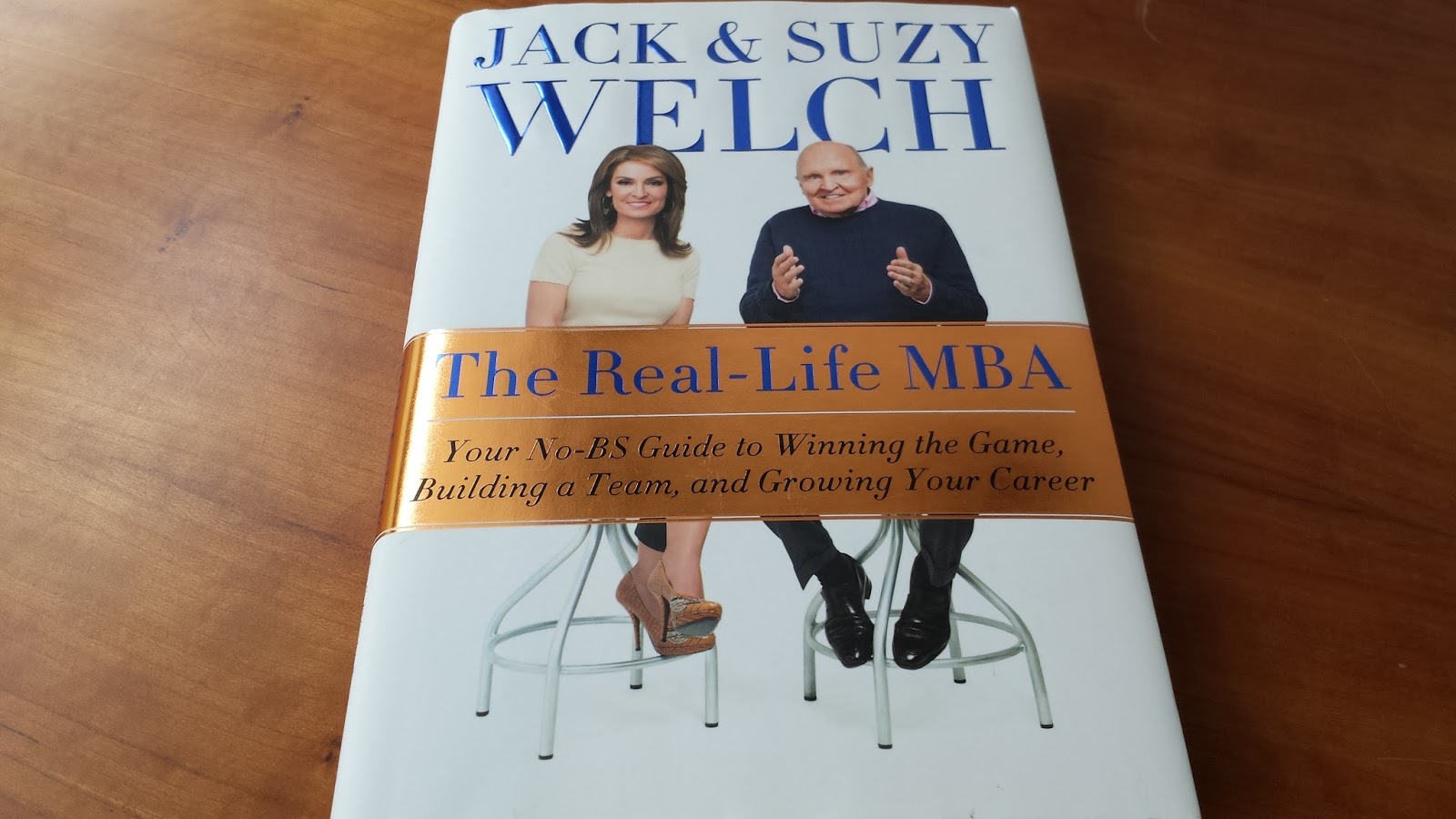
And, for that matter, there have been a number of articles in the Wall Street Journal, and elsewhere, about the opportunity divide, and the cost of college education, some of the other timely and relevant hot-button topics touched on in the talk. Now that I’ve read Jack and Suzy Welch’s book, I feel bad that Jack didn’t just point to Chapter 8, where he cites an example of a leader drawing out a dissenting opinion from a woman who might otherwise have remained silent at the table, stressing the importance of getting input from everyone. Looking around online, I see the terms “integrated diversity” and “thought diversity” associated with him. I have a feeling that Jack would describe himself as “blind” to any individual differences, and that he focuses only on the ideas and value that each person brings to the table.

Speaking from personal experience, though, it can be exhausting. When a woman manager says she needs to hire or make a purchase, she’ll probably have to talk to her management chain two or three or four times before being allowed to do so. It happens on the technical side, too. While helping to facilitate a study being conducted by a team of engineers, I raised an issue, and just as we had for prior issues raised, we discussed the validity of it. However, unlike the other issues raised and found to be valid, the lead engineer didn’t add it to the list. I was going to let it go, but the very respected senior male colleague in the room asked the individual if he thought it was a valid issue, and the individual said “Yes,” to which he said, “Well, then, write it down!” It sounds like a trivial thing, but imagine having to say everything two or three times before it gets heard or noticed. It’s tiring. And, this individual was a really nice guy. I’m sure that it wasn’t intentional, but it’s still frustrating.  

Even the night of the talk, while at dinner, Susan noticed the group dynamic at a nearby table, where the men were literally holding a separate conversation with each other, talking over and above the women sitting at their table, as if they were not even there. Even when a woman gains a seat at the table, she still may not be heard. This is likely the case for other minorities.

And, this is here, in a modern, civilized, progressive society. Reading the book, The Underground Girls of Kabul, by Jenny Nordberg, makes you appreciate the rights and freedoms enjoyed here, and makes your heart break for the plight of women in horribly backwards countries, such as Afghanistan, where a woman’ s worth is defined by her wedding dowry and her ability to birth sons. Jenny Nordberg is part sociologist, part anthropologist, and part reporter. Her book takes readers on a journey to explore the practice of parents ‘turning’ a girl into a boy, by dressing the girl in boy’s clothing, in order to gain greater honor for the family (a family with no sons is looked down upon) and possibly, magically, make it more likely that the next  child born will be a boy. This entire structure is based on bad science, given that the sex of a child is actually determined by the father’s sperm, and yet the blame for not birthing boys is placed entirely on the mother. One of the greatest challenges to change there is that it is impossible to hold a scientific or rational discussion with people who refuse science and are not rational.

These girls, dressed as boys, are known as bachaposh, and get to enjoy all the freedoms and liberties of boyhood – going to school, playing outside, flying kites, helping out at their fathers’ stores, and being treated as a boy. Until puberty, when they are turned back to being girls, and get married shortly thereafter. A hard transition, after living life as a boy.

Even in the U.S., there are differences in the way that men and women are treated, but it is far more subtle. Elizabeth Gilbert, before Eat, Pray, Love fame, wrote an article, titled “My Life As A Man,” for Gentlemen’s Quarterly (August, 2001), and reported on how differently she felt as she got into character, and how differently she was treated.

So, I can almost understand where a remark came from, after Bruce Jenner’s interview with Diane Sawyer, when Bruce revealed that he was transgender, feeling like a woman living in a man’s body, and wanted to transition to live life as a woman. One man was heard saying that he didn’t think many men would understand or be very sympathetic to a guy who wanted to be a woman. A friend who heard this remark responded, “How can you have anything but compassion, when you see someone hurting and in so much pain?”

I never did follow the Kardashians, but there was another unlikely source of wisdom as this story unfolded. Apparently step-daughter Kim Kardashian was very upset, and it was Kanye West who explained it to her this way: “I can be married to the most beautiful woman in the world, and I am. I could have the most beautiful little daughter in the world, and I do. But I’m nothing if I can’t be me. If I can’t be true to myself, they don’t mean anything.”

So, Caitlyn, welcome to the world, good luck, and just keep being you!

Or, to borrow a quote from Oscar Wilde:

Be yourself. Everyone else is already taken!

 Be confident, even when you’re afraid. Don’t let fear stop you. Or discomfort.

One of the best experiences in my life was getting a part in our high school musical senior year: Showboat. It definitely pushed me outside my comfort zone. And now, when I need to be someone a little braver and a little stronger than I feel at a given moment, I go to that place, such as when I’m raising my hand to ask a question, and someone is handing me a microphone. Don’t be afraid to ask for what you want, and for what you need. Have the vision to see doors and windows where there are now only walls, and see that change is possible.

To be continued…
 

Coming Next
Showboat and New Orleans re-visited. Saturday marks ten years since Katrina made landfall and the levees breached that morning, Monday, August 29th, 2005.


Post-Post Script
Thanks to Taylor Swift for her great quote during her acceptance speech at the Video Music Awards Sunday night, August 30, 2015:

“I’m just happy that in 2015 we live in a world where boys can play princesses and girls can play soldiers.”
 
And congrats to the first two women soldiers to graduate from Army Ranger School! First Lieutenant Shaye Haver and Captain Kristen Griest were among the graduating class of 96 soldiers who earned the honor on Friday, August 21, 2015.
 
Post Script
I am embarrassed to admit that, upon seeing myself on TV, my first reaction was, “Dang, that haircut looks good,” followed by “Gee, I wish I’d been a little more eloquent in asking my question.” Anyway, quite apropos, as I’d landed a seat at the talk, quite by surprise, next to Kenneth Wildes, the owner of the hair salon where Susan and I have been going for years. I was delighted to find a friend in the crowd.

Since the talk, there have been many highs and lows on the diversity front. Frank Kameny, long-time champion of LGBT civil rights for federal workers, was inducted into the Department of Labor Hall of Honor on June 23, 2015.
 
 
And just a few days later on June 26, 2015, the Supreme Court made its historic ruling on same-sex marriage. Truly, a historic day. Now, same-sex marriage is just marriage.
 
Since June, there have been other epic, pivotal, historic rulings by the Equal Employment Opportunity Commission in July, essentially recognizing that discrimination against transgender people or on the basis of sexual orientation in the federal workplace is discrimination covered under Title VII of the Civil Rights Act (Macy v. Department of Justice; Baldwin v. Department of Transportation).

http://www.eeoc.gov/federal/directives/lgbt_complaint_processing.cfm
 
And yet, even as we enjoy these advances here, we see in the news and on Twitter, the recent reports of ISIS executing ethnic minority men and boys, and taking the women and girls as their sex slaves. Gay men are also reported to have been the target of exceptionally brutal killings (beheadings, stoning, being thrown from buildings), simply because they are gay. It’s easy to understand how futile the hopes for change might feel in so many corners of the world.

In times like these, we need art to lighten our soul more than ever, to connect, and express ourselves, saying what words alone cannot.

 
Advance Notices:

Art Exhibit: Out of the Earth
Artist: Joe Caruso
Sep. 2 - 27, 2015
Receptions: Sep. 4, 11, 27
Gallery: Galatea Fine Art, 460B Harrison Ave., Boston, MA
http://galateafineart.com/
 

HUBweek
Oct. 3 - 10, 2015
Boston, MA
Check out the events posted so far, advance registration is available. Some are free and some require paid tickets. It’s an opportunity to get together with some of the great minds of Boston, use various locations across the city to gather in these various living rooms. The week-long event is described as “where art, science and technology collide” – or is it more of an intersection? Meeting? Merging? Fusion? What is the relationship between art, science and technology? What is our relationship with technology?

Registration is now open for 27 live events. My top picks right now are:
Sunday, October 4 - De-Stress Boston (hosted by Massachusetts General Hospital).
Sunday, October 4 – Fenway Forum: What’s The Right Thing To Do? A philosophy class at Fenway Park by Harvard Professor Michael Sandel.
Monday, October 5 - STEM Event (MGH)
http://www.hubweek.org/

Women In STEM Summit
Oct. 22, 2015
Bentley University, Waltham, MA.
http://www.iirusa.com/stem/home.xml


Boston Book Festival
Oct. 23 - 24, 2015
Copley Square, Boston, MA
http://www.bostonbookfest.org/


References

Brandpoint. 2015. Why a diverse workforce works. March 25, 2015.
 
Guynn, Jessica, 2015. Diversity Gets Googled. USA Today. May 7, 2015.
http://www.pressreader.com/usa/usa-today-us-edition/20150507/281908771709143/TextView

Nordberg, Jenny. 2014. The Underground Girls of Kabul: In Search of a Hidden Resistance in Afghanistan. New York: Crown Publishers.

Welch, Jack, and Suzy Welch. 2015. The Real-Life MBA: Your No-BS Guide to Winning the Game, Building a Team, and Growing Your Career. New York: HarperCollins Publishers.

© 2015 Rosemary A. Schmidt
Rose Schmidt is the author of “Go Forward, Support! The Rugby of Life.” Use of individual quotes with proper citation and attribution, within the limits of fair use, is permitted. If you would like to request permission to use or reprint any of the content on the site, please contact me. The opinions expressed herein are solely those of the author, and do not reflect those of any other entity, person, agency, or organization.

Monday, August 10, 2015

Business & Baseball: A Conversation with Jack Welch and John Henry, Moderated by Brian McGrory


I had the distinct privilege of attending this talk, really a conversation with Jack Welch (former CEO of GE) and John Henry (owner of Red Sox, NESN, Liverpool soccer club, and The Boston Globe), moderated by Brian McGrory (Editor of The Boston Globe), held Wednesday night, April 22, 2015, at the Seaport Hotel, in front of a crowd of nearly 500, plus the NESN camera crew. An abridged, edited one-hour version has aired on NESN, and so I am here to fill you in on what you missed, and then pick up where the talk left off. I’m sure the show will air again one of these days during a rain delay.


Jack Welch quickly steals the show with the first few questions about his latest book, titled The Real-Life MBA, written with wife and co-author, Suzy Welch. He repeatedly pushes the key  principles of alignment and engagement in business, and their mantra: tell people where you’re going, why you’re going there, how you’re going to get there, how they fit in, and what’s in it for them.

Jack is a virtual firecracker: hot, fun, loud, and probably more than a little dangerous. He has a sparkle and a glow. And he’s on a roll, as you realize that this is just one stop along his book tour, taking every chance to also promote his online MBA program, his view of business, the economy, and the world.

The room is filled with adoration and admiration for both men. They are clearly as different as night and day. Jack is homegrown, originally from Salem, with a heavy Boston accent. While a chemical engineer by education, he is the textbook charismatic leader. He’s excited – and has an opinion – about everything. I can see why people would follow him. John is a Midwesterner, originally from Quincy, Illinois. That’s Quincy, pronounced properly, “Kwint-see,” which is located along the Mississippi River just a bit downstream of the Quad Cities (please refer to my prior blog post, “Poutine,” published June 12, 2015). John arrived in Boston by way of California, studied philosophy, and followed a more varied career path (if I trust Wikipedia anyway), playing in a couple of bands, and trading commodities. In some ways, I can relate to both of them. My first major (not my last) was chemical engineering, and I think of myself as an amateur philosopher.   

When Brian turns the first question over to John Henry, asking him why he purchased The Boston Globe, John responds: “I must not have had enough challenges.” A very Midwestern reply. “Ha, ha, this is very funny,” I think in my head, but it falls flat and is greeted by only an awkward silence from the audience. My heart is breaking for him. He tries to recover: “Not very funny, I guess.”  

I can’t count the number of times my Dad has said, “Life is about challenges, Rosie,” followed by his tales of how he dug and poured the foundation himself for his first bakery in Plainfield, Illinois, or bought a gutted-out house and re-built it.  We’re not good at sitting around; we always have to have a project that we’re working on.

In a few words, John explains that he wants to be involved in the next phase of journalism, citing its importance to the community. Of course, longer and more eloquent versions of this answer have been published in the Boston Sunday Globe in a full-page editorial piece in October 2013, and in the interview by Jason Schwartz in Boston Magazine in March 2014. Then Brian asks Jack what his advice would be, given the titanic changes shaking the industry, with digital competition and changing readership. Jack agrees that it’s a changing world, where it’s “analog dollars to digital pennies” and it’s “fabulous if you can move faster than the next.” This is not helpful, I think to myself, but only further highlights the uphill battle newspapers face, as they deliver content both digitally and via the driveway. They have a foot in both the analog and digital worlds.  

This reminds me of a conversation with my Dad last summer on the topic of newspapers, and I mentioned that John Henry, owner of the Red Sox, had recently purchased the Boston Globe. “Geez, my God, Rosie, why in the hell would anyone want to do that?” he asked. He went on to complain about the decline in the local newspapers, though he still gets the Chicago Tribune.

Later on in the talk, Brian asks Jack about his 2006 bid to purchase the Globe, and you get a sense that, while Jack had wanted to make the purchase at the time, he might not be regretting that things didn’t work out so much now.

What is the future of newspapers? The only sure thing is that it will be different. Yet, the free press plays such a vital role in providing local insight and analysis of news, in fact sometimes defining what is actually considered news, and shaping a community’s experience of the news . There are just so many new choices. Just as “video killed the radio star,” the internet and the myriad of social media are all challenging conventional news delivery. If Paul Revere could have tweeted it out that the British were coming, instead of going on his midnight ride, he probably would have, wouldn’t he? The first I heard about Ferguson (one year ago) was from a tweet by Tyler Glenn, lead singer of the Neon Trees, and not from any mainstream television or print media. Yet, I also fondly recall feeding the quarters into the news stand to get my copy of the Sunday Chicago Tribune, to read about the world, plus the column of that smart, smart Boston woman, Ellen Goodman.  I wax nostalgic.

But I’ve digressed – back to the talk.

What’s clear is that we are in polite company. There will be some good-natured ribbing, but after all, Brian is interviewing his boss, and Jack and John are essentially houseguests in the Globe’s living room, and no punches are going to be thrown. That’s okay, there is still plenty to be learned from the conversation. The closest we get to a controversial question is whether John knew that Jon Lester had the yips throwing to first base. Answer: No. Of course, what I really wanted to ask at that point is whether there was really fried chicken in the club house in 2011, but I exercise surprisingly great restraint.

Brian calls The Real-Life MBA a “deeply wise book,” and quotes what Jack calls “truth-and-trust” leadership, “relentlessly truth-seeking and trust-building,” a culture where “everybody knows where they stand.” If you have this, Jack says “you’ve got a company that hums! You’ve got the game by the tail!” The problem is that most businesses don’t have this level of transparency. “In baseball, you have transparency.  Every player’s batting averages are in the paper. In business, you don’t have that. People don’t talk candidly.”

Brian jokes, “I’m about to ask John where I stand,” and gets some laughter from the crowd. He’s funny.

Jack goes on to say that people should be told where they stand once a quarter. “That’s not cruel. That’s kind management.” He cites the results of a Gallup study that found 65% of employees are not engaged. “Imagine, in football or baseball, what if 65% of the players stayed in the dugout!” People should know where the business is going, and what’s in it for them, and be given a sense of purpose. This lack of engagement – “this is a tragedy, it’s not fun or enjoyable, and it’s not winning, in baseball or business.”

It’s like having fried chicken in the clubhouse, I think.

Brian reads a quote from the book about leadership. Jack responds: “If you’re the smartest guy in the room, as a leader, you’ve got a problem. Everyone knows something you don’t know. You’ve got to get every mind in the game.” Earlier, when asked about what makes Boston unique, Jack recalled how much he enjoyed the Boston business world, always “a bunch of Italians and Irish screaming at each other, and it’s fun.” (To those of a more Midwestern persuasion, this might sound more like holidays at the in-laws.)

“Companies have to be aligned,” Jack says. When he was at GE, with 400,000 workers, “every single person” knew where the company was going, why, and what was in it for them. “Business truly is like baseball, it’s just not as transparent,” he hollers.

Brian asks them both how important luck has been for them, relative to skill and hard work. John Henry recalls being told by Bill James (a baseball numbers guy), that 80% of the results in any game is due to luck. But, John Henry counters, that it’s the 20% skill, and more so determination, spread across the course of 112 games that makes the difference in a season. Especially determination – that belief, saying “I will not be denied.” 

I’d never realized it, but the reason why baseball teams play a series of three or four games, is because chance and luck play such a huge part in the game, and so winning one game doesn’t really prove much, but winning two out of three or three out of four does. It was my cookie-craving rabbit-finding friend from the first post who filled me in on this, years ago.

Jack agrees, that luck has been huge for him as well in his career. And, I would heartily agree.

It’s funny, when talking to young job candidates, and they’re asked which is most important – luck, skill, hard work, or determination – they typically answer hard work and determination. They just can’t see all the chance events that led to where they are today. From where they sit, all they’ve seen is that persistence leads to results, just as a lab rat gets through a maze, learns to hit a button and get a reward of kibbles. Hard work results in a reward. Of course, this speaks to the heart of Dr. Martin Seligman’s study of how our sense of control shapes our viewpoint. People who see good things as happening because of what they did, and attribute bad things to just bad luck or timing (and no personal causal culpability) are generally more optimistic – and happier.

I recall thinking this same way myself, when I was younger, that I didn’t get to where I was by lying about on the couch all day eating bon-bons. But, I have also always known that I’ve been lucky in a thousand different ways. Hard work and luck both play a part. It helps to work hard. To cite a quote from Dr. Louis Pasteur: “Fortune favors the prepared mind.” (I also found this in my fortune cookie once, too.)

I have to laugh, though, thinking of how many a manager has probably thought the same thing, that it was all purely their skill and strategy that led to hiring the best qualified candidate – but that was probably luck, too! Many a manager has probably sprained a shoulder patting themselves on the back for making a great hire, when it was all luck of the draw, and/or the hand of fate.  

Jack then speaks to the younger attendees in the audience, describing how their managers might be bringing them around the office, by the scruff of their neck, showing off their new hire to everybody. “Hey, look at me, I just got me an engineer from MIT!” I love the imagery, the mother cat carrying its kitten. And it’s so true. Hiring is a joyous event, a cause for celebration. Fun. He also has plenty to say about the other side of things, when someone has to be let go, and gives his perspective on “getting whacked.” Later in the Q & A period, when an audience member asks about dealing with the bottom 10 percent, he grouses a little bit. “I’ve never been asked about how to deal with the top 20 percent.”

Brian’s next question is about pay disparities, and is it okay for CEOs to make huge sums of money, many times what the average employee is making. Jack’s answer: “Yes, if the shareholders are making it, and the employees are flourishing, then they’re winning the game, too. You’re interested in everyone getting their piece of the pie.

John Henry remarks that “maybe it’s not a problem of income inequalities so much as it’s about opportunity inequalities, from the time that a child starts pre-K, and in fact a lot of children probably can’t afford pre-K; though not a problem for us to solve…” His voice trails off, but you can tell that it tugs at him.

Jack’s answer is “more jobs, GDP, and education reform,” criticizing the traditional education system (expensive, tenured), and promoting the pluses of his online MBA program (improved quality, delivery system, and price).

It’s clear that business is not going to fix society’s ills. Not their problem to solve. Let business thrive and provide jobs. That’s what business can do. Highly ironic, I think, given the preceding discussion of luck vs. hard work and determination. Are some opportunities afforded only to the lucky ones? Luck alone will never open some doors.

The first question from the audience asks about how Jack came to be called “Neutron Jack” back in the 1980s. He was in the midst of streamlining, merging and selling businesses, removing layers, cutting staff, and outsourcing. “Not a moniker you want; wish it never happened, but we were ahead of the game.” Other companies eventually followed suit.

After listening to Jack for a while, you can start to see the world through his lens, where everything can be sorted into two bins, either good for business or bad for business. There are simply things that will help it thrive, and those that will threaten its prosperity. When you look through this lens, things start to make sense. GE may have brought good things to life, but it also brought PCBs, too. Environmental compliance is a necessary cost, but still a cost that goes against the bottom line. Later, a woman in the audience asks about STEM outreach. No, it’s not an area he has gotten into. After the talk, I hear another attendee ask him about sustainability, and the answer is the same. These things – STEM, sustainability, and the environment – are tangential, and not on the line forming the shortest path between investment and return.

The second question from the audience is from a fellow who works in manufacturing. “How do you push alignment down to the shop floor?” he asks. Jack tells him that it’s all about going out and talking to groups of employees. “No leader should be hiding in their office; they should be out telling the story,” noting all the social media tools now available. (Jack Welch has about 1.4 million Twitter followers at last check.)  Jack elaborates on this a bit, and at some point John Henry remarks that he doesn’t necessarily agree with everything that Jack is saying, “but I’m not going to argue business with Jack Welch.”

Now, this I find fascinating, because it is precisely the sort of disagreement in approach, method, style, tactics, and philosophy in leadership that is worth exploring. Jack’s advice perhaps works best for Jack and others like him. But, all leaders are not Jack-Welch types. It just matters that a leader be authentic and true-to-themselves in their leadership style. What I found so fascinating in this exchange is that, even though Jack has preached so hard about “getting all the minds in the room,” he has just shut John down, or at least made the prospect of crossing swords with him seem too daunting a task. The challenge to getting participation and input from everyone is creating a space that is conducive to the free exchange of ideas.

In that one single moment, there was such a lost opportunity to examine these different styles.

Now, given that I’d obtained entrance to this event via a press pass (number two, for anyone who is counting), I had prepared some questions in advance, and there was a natural connection between this exchange and one of my questions. So, heart pounding, I raised my hand. If you happened to watch the show, or catch it on an inevitable replay during some future rain delay, that’s me asking the last question.  I wanted to try to use the exchange that just happened as a springboard for a broader question about fostering a culture of inclusivity. What came out was a bit less eloquent than I’d hoped, but here’s the gist of what I meant to say:

You’re both very successful leaders, but also very clearly have different styles. Given that studies show that increased diversity on teams leads to increased creativity and productivity, and yet studies also show that people are most comfortable working with those who are most similar to themselves. Given that, how do you encourage diversity within your organization?

Jack gave his standard answer: “Get everyone in the room together, have a food fight up front, get input from many different minds, then decide on a course, and get everyone on board. You want to get every brain in the game.”

John answers that he “knows that the decisions he makes every morning have far-reaching effects on many people. He’s always thinking about who will be affected and how.”

Yet, both missed a golden opportunity to speak to the elusive goal of figuring out how to reap the benefits of diversity, by fostering a culture that gets past the discomfort of working with people from different backgrounds. The answers weren’t wrong, they just could have been so much more.

To be continued…
 

Post Script
After a few more grand detours – work, travel, and a tiny bout of food poisoning thanks to an errant roast beef sandwich – I finally wrote up my account of the “Business & Baseball” talk. Ironically, shortly after this episode, the Wall Street Journal tweeted “About 48 million Americans, or 1 in 6, get sick each year from food,” which I re-tweeted: “Make that 48 million and two.” There’s nothing like lying on the couch Googling various types of foodborne illnesses and trying to guess which one you have. For a while, I thought I would never eat anything else but saltines and ginger ale ever again, but have since managed to bounce back.  

While I’ve been out, I’ve also been catching up on my reading, and managed to finish Jack and Suzy Welch’s book, The Real-Life MBA, as well as Pete Rose’s book, My Prison Without Bars, and Jenny Nordberg’s book, The Underground Girls of Kabul. The added benefit of having attended the talk is that I can now hear Jack’s voice hollering off the pages. Seriously, every sentence would have an exclamation point at the end of it, if he had his way. I only regret that I can’t quite tell which parts should be in Suzy’s voice. I loved his description of their writing process, sitting and debating a topic over a few drinks at the bah (“bar” for non-Bostonians), and then Suzy going back to her “cave” to write. This is a whole new take on Virginia Woolf’s room – or cave – of her own.  “She can write like hell!” Jack hollers. They are clearly a dynamic duo.

For the studies mentioned in my question, please refer back to post #12, published Jan 27, 2015, titled “Challenge Yourself!”

Thank you to John Henry for the photo opportunity after the talk. I missed Brian McGrory and Jack Welch, unfortunately. Thanks also to The Boston Globe for the press pass.


In other news:

Thirteen out of fifteen of my Dad’s asparagus plants have sprouted.

The Diane Sawyer interview with Bruce Jenner aired on April 24, 2015 on ABC.
Caitlyn Jenner was introduced to the world on the July cover of Vanity Fair magazine June 1st.

And on June 26th, SCOTUS delivered the ruling recognizing same-sex marriage from sea to shining sea.

Congrats to the Seattle Saracens on their first place finish in the Division I Women’s Rugby Club National Championships, and to Beantown for a very competitive, hard-fought finals match on June 13th, 2015. Well played.

And, congrats to the US Women’s Soccer team for their World Cup victory!

 
Coming Next
Part 2: The Diversity Challenge. The conversation continues after the talk.  

 
Advance Notices:

Art Exhibit: Out of the Earth
Artist: Joe Caruso
Sep. 2 - 27, 2015
Receptions: Sep. 4, 11, 27
Gallery: Galatea Fine Art, 460B Harrison Ave., Boston, MA

http://galateafineart.com/

HUBweek
Oct. 3 - 10, 2015
Boston, MA
Check out the events posted so far, advance registration is available. Some are free and some require paid tickets. It’s an opportunity to get together with some of the great minds of Boston, use various locations across the city to gather in these various living rooms. The week-long event is described as “where art, science and technology collide” – or is it more of an intersection? Meeting? Merging? What is the relationship between art, science and technology? 

http://www.hubweek.org/

Women In STEM Summit
Oct. 22, 2015
Bentley University, Waltham, MA.

http://www.iirusa.com/stem/home.xml


Boston Book Festival
Oct. 23 - 24, 2015
Copley Square, Boston, MA

http://www.bostonbookfest.org/
 
References

Henry, John W., 2015.  Why I bought the Globe. The Boston Sunday Globe. October 27, 2013.
https://www.bostonglobe.com/opinion/2013/10/27/why-bought-globe/QmFHhvRGFajQh1oMcAJ64M/story.html

Landro, Laura, 2015. Foodborne Illness Risk Lives On. The Wall Street Journal. July 6, 2015.

http://www.wsj.com/articles/foodborne-illness-risk-lives-on-1436202544

Nordberg, Jenny. 2014. The Underground Girls of Kabul: In Search of a Hidden Resistance in Afghanistan. New York: Crown Publishers.

Rose, Pete, with Rick Hill. 2004. Pete Rose: My Prison Without Bars. USA: Rodale.

Schwartz, Jason, 2015. Will John Henry Save the Globe? Boston Magazine. March, 2014.
http://www.bostonmagazine.com/news/article/2014/02/18/john-henry-boston-globe/

Seligman, Martin E. P. 1990. Learned Optimism. New York: Vintage Books, a Division of Random House.

Welch, Jack, and Suzy Welch. 2015. The Real-Life MBA: Your No-BS Guide to Winning the Game, Building a Team, and Growing Your Career. New York: HarperCollins Publishers.

© 2015 Rosemary A. Schmidt
Rose Schmidt is the author of “Go Forward, Support! The Rugby of Life.” Use of individual quotes with proper citation and attribution, within the limits of fair use, is permitted. If you would like to request permission to use or reprint any of the content on the site, please contact me.

Friday, June 12, 2015

Poutine


Poutine roughly translated from the French-Canadian means “mess,” and that’s just what you get when you allow too much time – and too many topics to build up – between blog posts. My apologies for the long silence. I went on a little travel, and am just catching up now. So, consider yourself forewarned, this post is a bit of a mess.

Poutine is also a French-Canadian delicacy consisting of fried potatoes, brown gravy, and cheese curds. I got the chance to try this tasty treat while visiting the Quad Cities, nestled along the banks of the Mississippi River where it forms the Iowa-Illinois state line. As we remarked to the waiter, “This will be the best poutine we’ve ever had. Because it’s also the only poutine we’ve ever had!” All but my youngest grandniece tried it. She thought it smelled like dog food. Next we went for an ice cream treat at Whitey’s, and as we were getting back into the car where the leftover container of poutine had been left sitting, we all let out a collective groan: “The car smells like poutine!”. No one is going to be coming out with a poutine-scented air freshener or Yankee Candle anytime soon.

I would apologize for the digression, but this entire post is a digression, maybe even a grand detour, before getting back to the Business & Baseball post.

In my travels, I actually made it to all four of the Quad Cities, hitting the Wal-Mart in Bettendorf, Iowa; the Front Street Brewery in Davenport, Iowa, where we had the poutine; Huckleberry’s Pizza in Rock Island, and finally the Olde Towne Bakery in Moline, Illinois, where I found the best cream horns ever. This makes up just a little for the time I spent a couple of years ago in my fruitless search for bismarks in Bismarck, North Dakota. And, no one even got it, when I asked for a bismarck. That should have been funny. Bah! I could not find a bismarck in Bismarck. They’re missing out on a major tourist attraction there. What a missed opportunity. The cream horns alone were worth the trip to Moline, though.


While we were there, we also visited the John Deere Pavilion and had a blast crawling all over and getting inside the various farm implements they had on display, and purchasing the obligatory souvenirs and T-shirts. We never knew how enamored we were with John Deere and his story of farm implement innovation, making perhaps the first self-scouring steel plow in 1837. And there is a New England connection. He originally came from Rutland, Vermont. Talk about optimism, persistence, determination, and fearlessness. He had borrowed money to build his blacksmith shop there in Vermont. It burned down, and so he borrowed some more money and re-built his shop. It burned down again. Figuring that it was unlikely that his lender was going to say, “Hey, third time’s the charm,” he set off for Grand Detour, Illinois, with $73 in his pocket, and went about making a living there, earning enough to pay off his debts in Vermont and pay for his family to travel out and join him, and the rest is history.

Grand Detour. What an apt name for a town. It’s actually named for an unusual twist and turn that the Rock River takes, where it flows to the north briefly, a brief aberration before returning to the southwestwardly flow typical of the streams in this area as they make their way toward the mighty Mississippi. Suffice it to say, that sometimes our lives (and blogs) take just such detours.

And history is never without controversy. When you go back and talk to folks around Chicago, there is also the story of John Lane who also created a steel plow from an old sawmill blade at his blacksmith shop in Lockport, Illinois, in 1834 (Stanley, 1994). He also came from out east, where wood plows worked okay in the sandier soils, but the rich soils of the Midwest would tend to stick to the plow and gum things up. John Lane was selling his plows, called “Lockport Clippers” and “Sod Breakers,” in the Chicago area by the 1850s.

Later on, when I give my Dad his John Deere T-shirt that I brought back for him, he remarks, “Well, to be honest, I personally liked the McCormick tractors. Now, don’t get me wrong, they were both powerful tractors, but the McCormick ran better.” There is a long, complicated history of farm implement manufacturers, such as Deering, McCormick, and others working in direct competition with each other, then getting bought by J.P. Morgan and merged in 1902 to form International Harvester, and then getting split and sold off again much later in parts and pieces.  It’s a cautionary tale for any business. The International Harvester Scout was a great car, a ton of fun, and the original SUV. But a flawed business model and a woeful 12 mpg simply made it unsustainable. Every once in a while I try to revive my one-person campaign to Bring Back The Scout. I am not terribly hopeful or optimistic.

While I’ve been out, I’ve also been catching up on my reading. I wanted to finish Jack and Suzy Welch’s book, The Real-Life MBA, but I was also in the middle of reading Pete Rose: My Prison Without Bars, and so I needed to finish both.

In the meantime, so many stories broke, so much news was made.

The Diane Sawyer interview with Bruce Jenner aired on April 24, 2015 on ABC.

Caitlyn Jenner was introduced to the world on the July cover of Vanity Fair magazine June 1st.

The New England Patriots #DeflateGate penalties were announced. Memorial Day was observed, reminding us not to confuse those things that we treat like life-or-death with things that really are. Robert Kraft made the right decision. Move on.

The Boston Red Sox drafted Clate Schmidt June 11th (no relation). Welcome to town, and wishing you all the best with your treatment.   

Ireland voted on a referendum Friday May 22nd, approving same-sex marriage. “A kiss for luck and we’re on our way…” Ukraine held its Gay Pride parade, KyivPride2015, along the Dnipro River June 6th. Boston’s Gay Pride parade will be held Saturday, June 13th. And, the new season of Orange Is The New Black starts Friday June 12th.

 
Beantown Women’s Rugby Football Club will be playing the Seattle Saracens in the Division I Club National Championships Saturday evening, June 13th, at Infinity Park, in Glendale, Colorado. Good luck, Town! There is still time to donate to help fund the team’s travel costs.

http://www.youcaring.com/sports-fundraiser/send-beantown-to-nationals/355542
 

 Go Forward, Support!

Go Town!
 

Coming Next
I will give my take on the talk, “Business & Baseball,” held Wednesday night, April 22, 2015, at the Seaport Hotel, an interview with two local Boston business icons, Jack Welch (former CEO of GE) and John Henry (owner of The Boston Globe, Boston Red Sox, and the Liverpool Football Club, and by “football” I mean soccer), moderated by Globe Editor, Brian McGrory.
 

References
Stanley, Charles, 1994. Plow Inventor’s Role Still Buried in History. The Chicago Tribune. May 27, 1994.


© 2015 Rosemary A. Schmidt

Rose Schmidt is the author of “Go Forward, Support! The Rugby of Life.” Use of individual quotes with proper citation and attribution, within the limits of fair use, is permitted. If you would like to request permission to use or reprint any of the content on the site, please contact me.